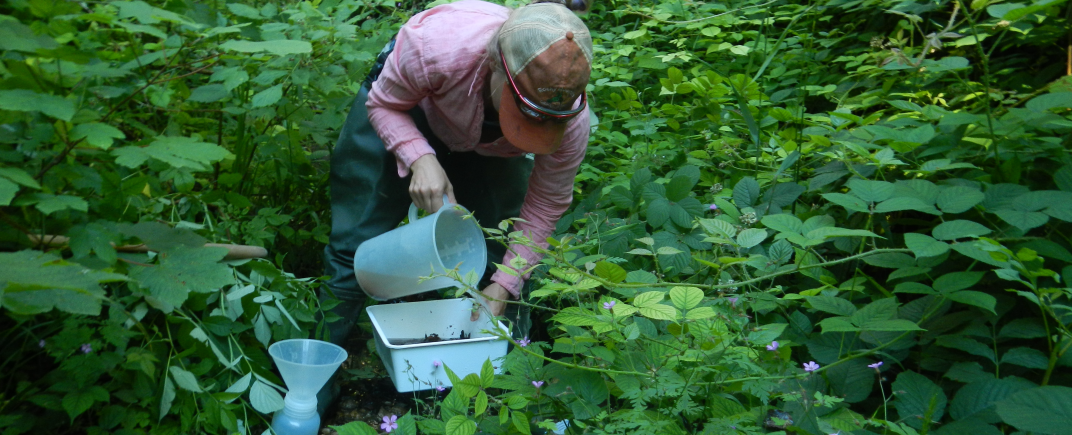
The Little Ecology Group has interests in ecology and evolution. These interests are united into a research program that uses theory, fieldwork, and data synthesis to examine the structure and function of ecological communities in space.
A few aspects of our current and past research are:
Community Assembly and Biodiversity
One of the central questions in ecology is, why are species found where they are? We are interested in the interplay between organisms’ ability to get to an ecosystem (see above) and their ability to persist once there, interact to shape community composition and structure, and ultimately the community’s contribution to ecosystem functions. We are especially interested in how these dynamics are modified by the structure of landscapes, e.g. through dispersal limitation, and on how communities respond to disturbance and longer-term global change. We study community ecology processes in the field with both experimental and observational approaches.
Current Projects:
- Through the NSERC-funded Alpine Horizons project and with funding from the B.C. Parks Living Lab Program, we are working in B.C.’s Coast Mountains to understand how terrestrial and freshwater biodiversity is spread across alpine landscapes in an era of global change.
- Initiated through the sPriority working group, funded by the German Centre for Integrative Biodiversity Research (iDiv), we are advancing a data synthesis to understand the prevalence and magnitude of priority effects across experimental contexts.
Past Work:
- Stroud J.T., et al. (including Little C.J.) (2024) Priority effects transcend scales and disciplines in biology. Trends in Ecology & Evolution 39:677-688.
- Little C.J. and Altermatt F. (2018) Do priority effects outweigh environmental filtering in a guild of dominant freshwater macroinvertebrates? Proceedings of the Royal Society B: 285:20180205.
Watershed Meta-Ecosystems
Freshwater systems have an extensive interface with the terrestrial world: river networks snake across a matrix of land. Classic work in ecosystem ecology established that a large part of the material and nutrients in freshwater food webs come from the terrestrial side of this interface. We are interested in the fate of these terrestrial subsidies and their effects on freshwater ecosystem functioning. The configuration of both the terrestrial landscape, and of reaches and habitats within a river or stream network, is important to the quantity and distribution of resources, and their consumption by aquatic organisms. We use a combination of field surveys, experiments, and geostatistical modeling to tease apart these processes.
Current Projects:
- Several lab members are part of the PERCS project: Perennial Ecosystem Restoration for Carbon Sequestration in Canadian Agricultural Landscapes. We are particularly interested in how terrestrial ecosystem restoration could affect carbon dynamics in agricultural streams.
- We are working with colleagues at DFO to study salmon habitats in the North Thompson watershed.
Past Work:
- Little C.J. and Altermatt F. (2018) Landscape configuration alters spatial arrangement of terrestrial-aquatic subsidies in headwater streams. Landscape Ecology 33:1519–1531.
- Little C.J., Fronhofer E.A., Altermatt F. (2020) Nonlinear Effects of Intraspecific Competition Alter Landscape-Wide Scaling-Up of Ecosystem Function. The American Naturalist 195(3):432-444.
Global Change in Tundra Communities
The Arctic is warming faster than almost anywhere else on Earth, and species face parallel threats in alpine ecosystems. One of our best options for understanding what effect future climate change might have on natural ecosystems comes from long term manipulations. Our group’s work also contributes to the Tundra Trait Team, which pooled tundra data to ask whether responses are similar across regions, community types, and functional groups, or whether heterogeneity of these responses make it difficult to predict the sum of global change effects.
Current Projects:
- Dr. Little took over leadership of the ITEX site in British Columbia in the summer of 2025 (more info here). Our group will continue to put up open-top chambers as part of the long-term warming experiment; will survey plants in control and warmed plots every two years; and will develop new research directions for the field site.
Past Work:
- Little C.J., Cutting H.B.U., Alatalo J.M., Cooper E. (2017) Short-term herbivory has long-term consequences in warmed and ambient high Arctic tundra. Environmental Research Letters 12:025001.
- Bjorkman A.D., Myers-Smith I.H., Elmendorf S.C., Normand S., … Little C.J.… et al (129 authors). (2018) Plant functional trait change across a warming tundra biome. Nature 562:57-62.
- Cooper E.J., Little C.J., Pilsbacher A.K., Mörsdorf M.A. (2019) Disappearing green: Shrubs decline and bryophytes increase with nine years of increased snow accumulation in the High Arctic. Journal of Vegetation Science 30(5):857-867.
Meta-Ecosystem Processes
The meta-ecosystems framework addresses the movement of organisms and material among ecosystems. Instead of considering only dispersal of organisms (as in a meta-community framework), a meta-ecosystem consists of patches (ecosystems) linked by movement of both resources and of living and dead organisms. Almost all ecosystems on earth are open to such flows, therefore considering meta-ecosystem processes is important even when the goal is to understand the dynamics of specific local ecosystems. We use the meta-ecosystem framework for empirical research in specific study systems, but also ask more general questions using data synthesis and theory.
Past Work:
- Little C.J.*, Rizzuto M.*, Luhring T.M., Monk J.D., Nowicki R.J., Paseka R.E., Stegen J.C., Symons C.S., Taub F.B., Yen J.D.L. (2022) Movement with meaning: Integrating information into meta-ecology. Oikos 8:e08892.
- Gounand I., Little C.J., Harvey E., Altermatt F. (2018) Cross-ecosystem carbon flows connecting ecosystems worldwide. Nature Communications 9:4825.
- Gounand I., Harvey E., Little C.J., Altermatt F. (2018) Meta-ecosystems 2.0: Rooting the Theory into the Field. Trends in Ecology and Evolution 33:36-46.
Dispersal
Dispersal is a key process in meta-communities and meta-ecosystems. While it is an important parameter in theoretical work, it is also a biologically very complex process. We are interested in inter- and infraspecific variation in dispersal, both based on organismal traits (condition-dependence) and environmental conditions and species interactions (context-dependence). We are particularly interested in the implications of intraspecific variation in dispersal on ecosystem function, and also on how landscape structure affects movement and dispersal.
Past work:
- Straus S., Forbes C., Little C.J., Germain R.M., Main D.A., O’Connor M.I., Thompson P.L., Ford A.T., Gravel D., Guzman L.M. (2024) Macroecological constraints on species’ ‘movement profiles’: Body mass does not explain it all. Global Ecology & Biogeography 33:227-243.
- Little C.J., Fronhofer E.A., Altermatt F. (2019) Dispersal syndromes can impact ecosystem functioning in spatially structured freshwater populations. Biology Letters 15:20180865.
- Fronhofer E.A., Legrand D., Altermatt F., Ansart A., Blanchet S., Bonte D., Chaine A., Dahirel M., De Laender F., De Raedt J., di Gesu L., Jacob S., Kaltz O., Laurent E., Little C.J., Madec L., Manzi F., Masier S., Pellerin F., Pennekamp F., Schtickzelle N., Therry L., Vong A., Winandy L., Cote J. (2018) Bottom-up and top-down control of dispersal across major organismal groups. Nature Ecology & Evolution 2:1859–1863.
 The Little Ecology Group